
Over recent weeks there has been a noticeable change in the tone of global financial markets. Equity markets remain relatively strong, but bond markets are sending a more cautious message. Government bond yields have moved sharply higher across a number of major economies, including Australia, the United States, Japan and Europe.
This matters because bond markets ultimately establish the price of money. When government bond yields rise, the return investors demand from almost every other asset tends to rise with them. That typically adversely affects shares, property, infrastructure, private equity and fixed-rate credit, as prices adjust to compensate investors for the higher required return. It also raises borrowing costs for households, businesses and governments.
The investment world is adjusting to a structurally higher cost of capital.
For much of the period following the Global Financial Crisis, investors became accustomed to very low interest rates. Money was abundant and, for long periods, extraordinarily cheap. That environment supported higher asset prices because future profits and cash flows were discounted at very low rates.
Australia’s 10-year government bond yield has recently surged through 5% and, at around 5.2%, is trading at levels not experienced since 2011. The US 10-year Treasury yield has also approached 5%, while Japanese bond yields have reached levels not experienced in decades. Persistent inflation, very high government borrowing requirements, energy-market disruption and enormous capital requirements associated with AI, data centres and related infrastructure are all competing for the same pool of global savings.
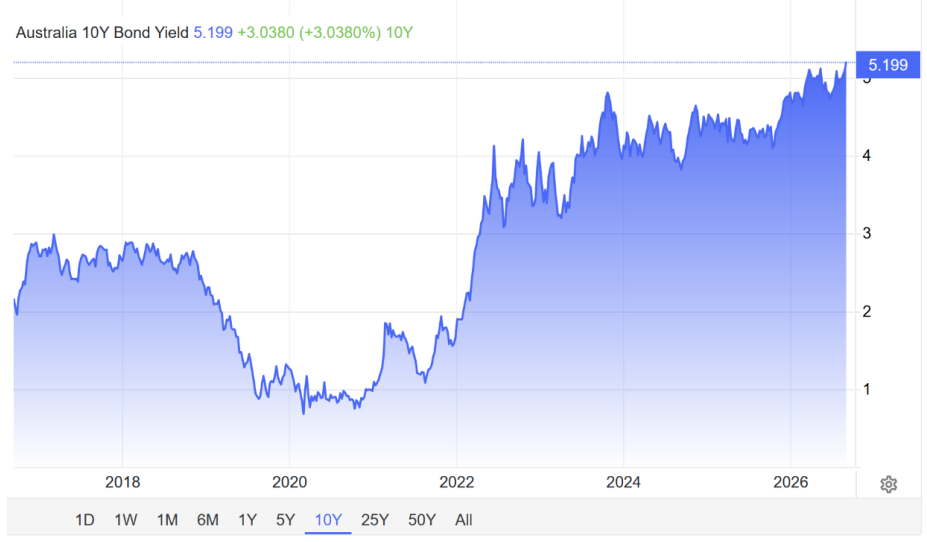
Put simply, there are a lot more borrowers competing for capital and the price of that capital is rising.
Australia is not immune
The domestic interest-rate debate is likely to become increasingly prominent over coming months.
The RBA cash rate currently stands at 4.35% following three increases this year. July CPI inflation was 3.5%, while the more important trimmed-mean measure of underlying inflation remained at 3.6%. The RBA has also stated that inflation is likely to remain elevated for some time and that the risks to the inflation outlook remain skewed to the upside.
While higher global oil prices are contributing to the inflation risk, the continuing strength of publicsector demand also remains a concern. Federal and State governments continue to spend heavily at a time when the RBA is attempting to restrain aggregate demand. The RBA itself expects public demand to continue supporting economic growth.
This is not a political observation; it is an economic one. If monetary policy is attempting to slow demand while fiscal policy continues to support it, a greater share of the adjustment ultimately must occur through higher interest rates.
Recent economic data has strengthened the argument that further tightening may be required. Australia’s economy grew by 0.4% in the June quarter, compared with expectations of 0.3%, while annual growth accelerated to 2.1%, ahead of expectations for 1.8%.
According to Trading Economics, following the GDP release, markets increased the probability of a fourth RBA rate increase at the September meeting to approximately 58%, from 48% previously. More significantly, one additional 0.25% increase is now effectively fully priced by November, while the probability of a further increase during the first quarter of 2027 has risen to 82%, from 62%.
In practical terms, markets are therefore effectively pricing one further rate rise by November, with an 82% probability of another increase during the first quarter of next year. If both were to occur, the cash rate would increase from the present 4.35% to 4.85% by the end of March 2027.
These probabilities will change as new inflation, employment and economic-growth figures are released. Nevertheless, they demonstrate how dramatically expectations have shifted. Not long ago the debate centred on when interest rates might fall. Increasingly, the question is how many further increases may be necessary.
Government finances also feel the impact
Higher bond yields do not only affect households and private investors. They also increase the cost of financing government.
Australian Government gross debt is forecast to reach approximately $1.05 trillion during 2026–27, equivalent to around 34% of GDP. As bonds mature and governments continue to finance budget deficits, debt must progressively be refinanced at prevailing market rates.
Australia remains in a considerably stronger debt position than many other developed economies, so we do not regard this as a question of the Federal Government’s ability to meet its obligations. The more relevant issue is the increasing cost of refinancing that debt.
The Australian Office of Financial Management expects to issue approximately $125 billion of Treasury Bonds in 2026–27. Treasury also assumes a weighted-average cost of approximately 4.8% on new Treasury Bond issuance over the forward estimates, up from 4.4% as recently as the Mid-Year Economic and Fiscal Outlook. If current 10-year Government bond yields of around 5.2% persist, this assumption may ultimately prove conservative.
The consequence is becoming increasingly visible in the Federal Budget. Commonwealth interest payments are forecast at approximately $29.6 billion this financial year, rising to $42.3 billion by 2029– 30.
This creates a constraint that governments ultimately cannot avoid. Every additional dollar required to service debt is a dollar that cannot be spent elsewhere without either increasing taxes, reducing other expenditure or borrowing still more.
This creates an uncomfortable feedback loop: strong government spending supports demand → inflation remains elevated → interest rates remain high → government refinancing costs increase → future budgets become more constrained and/or more taxation is required.
Governments can decide how much they wish to borrow, but ultimately investors determine the return required to provide the money.
Why bond yields matter to investment valuations
Government bond yields form the starting point for the return investors require from almost every other asset.
An investor deciding whether to buy a share, property asset, infrastructure investment or private business will naturally compare the expected return with what can be earned from a relatively lowrisk government bond.
If a government bond yields only 3%, an investor might be prepared to accept a 7% return from an equity investment — effectively demanding an additional 4% for accepting the greater risk associated with owning a business.
However, if the government bond yield rises from 3% to 5%, that investor may now require something closer to 9% from the same equity investment.
The underlying business has not necessarily become riskier. Rather, the risk-free alternative has become considerably more attractive, so the required return from taking additional risk must also rise.
This has a direct effect on valuation.
Assume an investment produces $1 of sustainable annual earnings indefinitely. At a required return of 7%, that $1 of earnings is theoretically worth $14.29. At a required return of 9%, exactly the same $1 of earnings is worth $11.11.
Nothing has happened to the underlying earnings. The approximately 22% fall in valuation occurs simply because investors now demand a higher return.
This is why movements in government bond yields matter so much to asset prices. Unless expected cash flows also increase, the price investors are prepared to pay must fall.
The impact is particularly significant for companies trading on very high earnings multiples, where a large proportion of their valuation depends upon profits expected many years into the future. Conversely, companies producing substantial cash flows today, carrying sensible debt levels and trading at modest valuations are generally much less vulnerable.
Higher rates also create opportunities
While parts of the equity market remain expensive, we continue to find individual companies where we believe underlying value is not fully reflected in the share price. Interestingly, as recently occurred with Steadfast Group, corporate buyers appear to be reaching the same conclusion, with some examples below.
Cleanaway Waste Management (CWY) – CWY provides essential waste-management services through a substantial national infrastructure network. EQT Infrastructure originally made a conditional, nonbinding proposal to acquire Cleanaway at $3.13 per share, which has subsequently been adjusted for dividends to $3.095 per share. CWY’s Board has granted EQT a nine-week exclusive period to undertake due diligence and negotiate a Scheme Implementation Deed with a view to agreeing a binding transaction. Subject to an Independent Expert concluding that the offer is in the best interests of shareholders, the Board intends to recommend the offer in the absence of a superior proposal. Cleanaway is presently trading at approximately $2.60, suggesting around 19% upside should the takeover proceed.
OFX Group (OFX) – OFX specialises in global money transfers. The Company has entered into a transaction process with Equals Group for an all-cash acquisition at $1.00 per share. At the time of writing, OFX was trading at 82 cents, suggesting approximately 22% upside should the takeover proceed. The OFX Board intends to unanimously recommend that OFX shareholders vote in favour of the Scheme, subject to the parties agreeing the terms of the Scheme Implementation Deed on acceptable terms, the Board obtaining sufficient comfort regarding Equals’ debt funding package, no superior proposal emerging for OFX, and an Independent Expert concluding that the Scheme is in the best interests of shareholders. Equals Group has advised that it has substantially completed its due diligence and is working with a group of lenders to secure the necessary debt funding.
If the takeover offers for either of these companies do not come to fruition, we do not view either business as being demandingly priced at current share prices. We also see value in numerous smaller listed companies, with the recent release of full-year results providing some examples below.
Pioneer (PNC – $0.67) – PNC is a debt collection business that reported a jump in net profit to $23.1 million, up from $6.7 million in the prior year. Management’s three-year net profit after tax target for FY2029 is at least $35 million. If achieved, at PNC’s current market capitalisation of approximately $127 million, this would value the Company at only 3.6 times its targeted FY2029 NPAT.
Servcorp (SRV – $6.20) – SRV offers serviced offices both in Australia and around the world. FY2026 statutory NPAT increased 24% to $65.6 million, while underlying NPBIT increased 24% to $87.0 million. Importantly, the Company finished the year with approximately $152 million of unencumbered cash and no external gearing. At $6.20 per share, excluding the value of cash held by the Company, SRV is trading on approximately 6.9 times FY2026 statutory earnings. Management has guided to broadly similar underlying profit in FY2027, with greater benefits from its recent investment in new serviced offices expected thereafter.
Virgin Australia (VGN – $2.90) – VGN is Australia’s second-largest airline and sits between Qantas and Jetstar in its value offering. The Company reported a normalised 22% increase in net profit after tax to $404 million and declared a surprise 7.6 cent fully franked dividend. At $2.90, the Company is trading on an undemanding multiple of 5.5 times FY2026 underlying earnings and has provided a positive trading outlook. At some point, we expect major shareholder Bain Capital to exit its interest in VGN. Doing so will remove the current share-price overhang and the resulting increase in free float could ultimately broaden institutional ownership and improve the market’s recognition of the Company.
Zip Co (ZIP – $2.40) – ZIP is an Australian Buy Now, Pay Later provider focused on rapidly expanding in the large and underserviced US market. The Company delivered an extremely strong full-year result, including Cash EBTDA of $268.9 million, an increase of 58% on the prior period. ZIP expects further strong growth, with FY2027 Cash EBTDA guidance of approximately $340 million. ZIP has consistently delivered strong growth across its major operating metrics and, for FY2026, it was difficult to identify any significant blemishes in the result.
In recent discussions, we have also highlighted selected private-credit investments, including the MA Priority Income Fund and the Barrenjoey First Ag Credit Fund, the latter of which is available to Wholesale Investors only. Both have floating-rate characteristics, meaning prospective returns should benefit if short-term interest rates remain elevated or rise further.
While no lending is ever risk-free, we like the relative defensive attributes of both funds. The MA Priority Income Fund targets a return of the RBA cash rate plus 4% and has MA Financial Group coinvesting capital equal to 10% of the Fund’s total capital, providing a capital buffer for other investors. The Barrenjoey First Ag Credit Fund targets 6% to 7% above BBSW. While carrying greater risk through its exposure to agricultural businesses, the Fund is focused on the food and fibre sector and uses structures designed to transfer risk to quality institutional counterparties.
We maintain that investments such as these can provide an attractive combination of income and diversification in an elevated interest-rate environment.
The message is caution, not fear
The underlying price of capital has changed materially from the environment that prevailed for much of the past 15 years. The world is moving from an era in which capital was almost free to one in which governments, businesses and investors must genuinely compete for capital.
That environment should favour companies producing real cash flow, assets purchased at sensible prices that provide protection against inflation, investments with manageable levels of debt and income streams capable of adjusting with interest rates.
As always, our focus remains on preserving capital, generating sustainable income and achieving attractive long-term returns without taking unnecessary risk.
Please do not hesitate to contact our office if you have any questions on the above or your portfolio in general.

