
When diversification isn’t as diversified as it looks
Equity markets are again trading near record levels. On the surface, there is much to be positive about. US corporate earnings have remained resilient, artificial intelligence continues to attract enormous investment, and investors who have simply remained fully invested have generally been rewarded.
However, we are increasingly conscious that market leadership has become unusually narrow, valuations are stretched in some of the areas attracting the most capital, and traditional measures of risk appear to be receiving less attention.
At the same time, many good businesses are being overlooked.
Consequently, we are becoming more selective about where risk is taken and to ensure portfolios are genuinely diversified.
Diversification is not what it used to be
The US index ‘S&P 500’ is commonly regarded as one of the world’s great diversified investment exposures. Increasingly, however, that description deserves scrutiny.
The 10 largest companies now represent approximately 37.6% of the entire S&P 500, with Nvidia alone accounting for roughly 7.6% — more than the combined weight of the smallest 100 companies in the index. According to Citadel Securities, semiconductor companies now represent nearly 20% of the S&P 500 — the highest proportion on record and approximately four times their weighting in June 2020. One estimate suggests that when hyperscalers, cloud infrastructure, software and other AIrelated businesses are included, as much as 60% of the index’s valuation is influenced by the AI investment theme.
That does not make the S&P 500 a bad investment. It does mean that an investor buying it today is obtaining a materially different exposure from the broadly diversified US market of previous decades, with an unusually large concentration on technology related businesses and the AI investment theme.
Australia has the same problem in a different form.
Using the Betashare’s Australia 200 Exchange Traded Fund (ETF) as a current proxy for the Australian share market, approximately 35.1% of the portfolio is invested in financial companies and a further 29.4% in resources, including materials and energy. Together, these areas represented approximately 64.5% of the entire ASX 200.
The concentration becomes even more apparent when we look at the individual companies. CBA, NAB, Westpac and ANZ alone represented approximately 23.4% of the portfolio, meaning almost one dollar in every four is presently invested in the four major banks. BHP represents another 11.7% of the market. Consequently, these five companies alone — the four major banks and BHP — account for approximately 35.1% of the entire Australian share market.
An Australian investor holding a conventional market-cap weighted index therefore has a very substantial underlying exposure to the housing and credit cycle through the banks, and to commodity prices and global demand — particularly China — through the major resource companies.
When seeking diversification, traditionally often pursued via index funds, investors need to look underneath the hood and understand what they actually own.
Risk appears increasingly discounted
Another feature of the present market is the degree to which investors appear comfortable accepting risk.
One set of market-risk indicators we have been reviewing shows US margin debt reaching approximately US$1.42 trillion in May 2026, up 66% from US$850 billion only 13 months earlier. At the same time, a recent Bank of America (BofA) Global Fund Manager Survey cited average fundmanager cash levels at only 3.9% of assets and below BofA’s own 4% contrarian sell-signal level. The report also states that nearly half of surveyed fund managers were carrying no explicit hedge against a significant market decline.
None of these statistics predicts when a market correction will occur. Markets do not work that neatly. They do, however, tell us something about positioning. High leverage, low cash and limited downside protection is no problem while markets are rising. They become much more significant when something goes wrong because leveraged investors may become forced sellers at precisely the time when natural buyers have less cash available.
This is why we believe there is currently more underlying market risk than headline index levels suggest.
Technology is capturing the attention — value is not
One of the consequences of enormous capital flows into AI and momentum stocks has been a widening gap between fashionable and unfashionable areas of the market.
Over the last 12 months, the gap in performance between US momentum shares such as Nvidia, Tesla, Meta Platforms when compared to a basket of high-quality companies such as Johnson & Johnson, Procter & Gamble, Microsoft, Visa, and Nestlé has exceeded 30%.
This does not mean AI companies cannot continue rising. In time, some may more than justify their current high valuations as exceptionally valuable businesses. But it does demonstrate how indiscriminately capital can move when a powerful investment narrative takes hold.
At the other end of the spectrum are established businesses whose fundamentals remain sound, but whose stories are currently less exciting.
Locally, healthcare company ResMed provides a useful example. Our research notes earnings growth of around 25% over the upcoming three years, a balance sheet currently holding more than US$800 million of net cash and a return on invested capital above 25%. Yet the Company presently trades at approximately 17 times forward earnings compared with a five-year average closer to 25 times.
Another example is insurance retailer Steadfast, which had drifted down to around the $4.00 level prior to receiving a takeover proposal at $6.00 a share, despite continuing to exhibit the characteristics of a high-quality business. The Company consistently delivered steady earnings growth, resilient margins and strong cash flow and has delivered total shareholder returns in excess of 15% per annum since listing. The subsequent bid reinforced the extent to which the market had been underappreciating the durability of its earnings profile, and that disconnect has led to a takeover opportunity. This disconnect between short-term market pricing and underlying business quality highlights how sentiment-driven selling can create opportunities in otherwise high-quality franchises.
At the time of writing, Steadfast shares are trading at approximately $5.25, well below the $6.00 conditional, non-binding and indicative proposal price. The discount reflects, among other things, the risk that a binding transaction may not ultimately proceed. As such, there is still significant upside from here (~14%) should the takeover ultimately proceed.
The point is not that every inexpensive company is attractive. It is that when markets become preoccupied with one theme, fundamentally good companies elsewhere can become mispriced and can represent strong relative value.
For value orientated long-term investors, that creates opportunity.
Australia warrants particular caution
The Australian economic backdrop also gives us reason to remain cautious.
The latest available National Accounts show that the economy expanded by only 0.3% in the March 2026 quarter, with annual GDP growth of 2.5%. GDP per capita declined by 0.1% in the quarter, while GDP per hour worked fell by 0.6%. These figures reinforce the view that underlying economic and productivity momentum remains subdued. In real terms, Australia has been going backwards.
The Reserve Bank is also deliberately restraining demand. The cash rate currently stands at 4.35%, and the RBA has increased rates three times during 2026. Inflation remained at 3.8% in the year to June, still well above the midpoint of the RBA’s target range for inflation.
Perhaps most importantly for Australian investors, the RBA’s August Statement noted that housing prices have already “declined noticeably” and expects the economy to slow further as previous interest-rate increases work through households.
That does not guarantee Australia is entering a major housing correction. It does, however, make the risk considerably more credible.
This deserves attention because, as we have written extensively in the past, the major banks have been enormous beneficiaries of Australia’s long property boom. A prolonged housing downturn would result in slower to negative mortgage growth, softer credit demand and, if conditions became sufficiently difficult, higher arrears and bad debts.
That risk is amplified by the concentration discussed earlier. CBA, NAB, Westpac and ANZ collectively represent approximately 23.4% of the ASX 200. A material change in the outlook for Australian housing and credit therefore has implications well beyond bank shareholders — it potentially affects the performance of almost one quarter of a conventional Australian index portfolio.
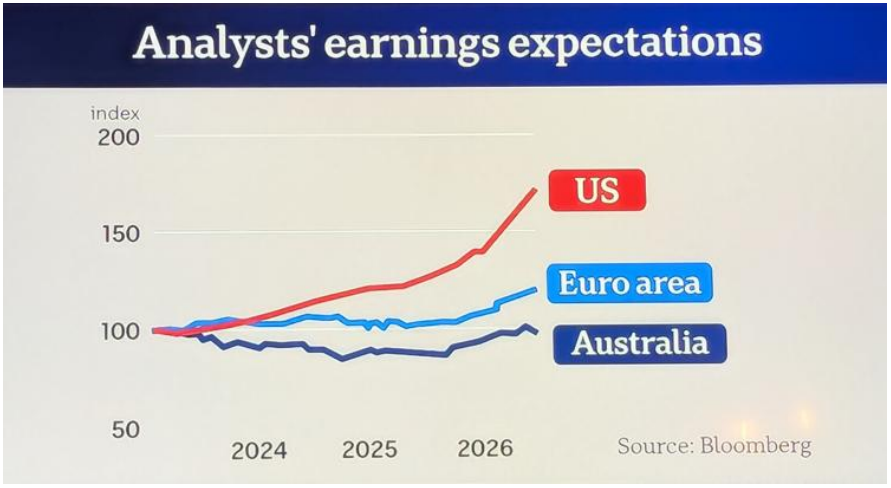
As Alan Kohler reminded us on the news earlier this week, there is a stark contrast developing between Australian and US earnings expectations.
The response is diversification, not retreat
Our conclusion from all of this is not that investors should move more heavily to cash.
Trying to predict the exact point at which markets turn is rarely successful. Equally, ignoring valuation and concentration simply because markets continue rising is not sound investment management.
We believe portfolios should increasingly combine different sources of return across different asset classes as per opportunities such as what we presented in last month’s letter. This brings us to an investment opportunity we are currently reviewing for inclusion in client portfolios.
JPMorgan Private Markets Fund (Product Disclosure Statement)
Interest in private equity is increasing because public equity markets have become so concentrated.
JPMorgan’s presentation makes the point that the investable corporate universe is considerably larger than listed markets suggest. Among larger US businesses, approximately 14% are publicly listed while 86% remain privately owned, and JPMorgan estimates the broader private-market opportunity set to be around six times that available through public markets.
Accessing that opportunity set effectively, however, requires significant scale and expertise.
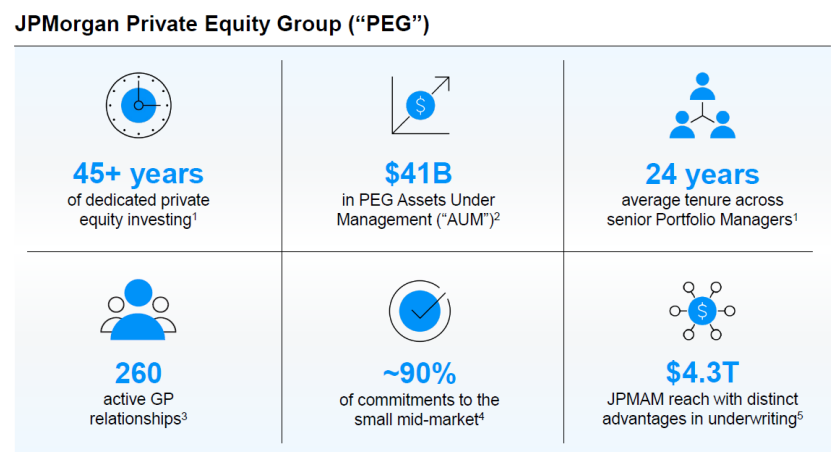
JPMorgan’s Private Equity Group has been investing in private equity for more than 45 years, manages approximately US$41 billion, maintains relationships with around 260 private-equity managers, and its senior portfolio managers have an average tenure of approximately 24 years. Around 90% of commitments across the platform have historically been directed to the small and middle market.
We regard the small and middle market focus as important. Public markets have increasingly become dominated by enormous businesses in specific sectors. Private equity provides access to companies at an earlier point in their development across a wide range of sectors of the economy and to industries and business models that may be poorly represented in listed markets.
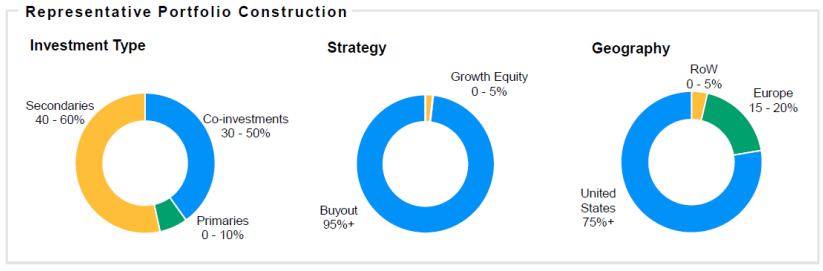
The JPMorgan fund is also diversified within private equity itself. Its representative portfolio is expected to hold approximately:
• 40–60% in secondaries – investments where the fund purchases existing stakes in private equity funds
• 30–50% in co-investments – direct investments made alongside private equity managers into specific companies
• 0–10% in primary fund investments – traditional commitments made to newly formed private equity funds at inception, where capital is drawn down over time and invested by the fund manager across a portfolio of companies.
Geographically the fund will be invested 75%+ in the US, 15–20% Europe and 0–5% elsewhere.
That mix is attractive to us.
Secondaries involve acquiring interests in existing private-equity investments rather than waiting many years for a new fund to deploy capital. This can shorten the path towards distributions and diversify investment vintages. Co-investments allow JPMorgan to invest directly alongside selected private-equity managers in individual businesses. Primaries provide access to newly established funds and managers.
JPMorgan also expects the underlying strategy to maintain a long-term liquidity bucket of approximately 20% to assist with capital deployment and investor redemptions.
Private equity can also play a useful role in improving how a portfolio behaves over time.
JPMorgan’s research looks at long-term industry data going back to 1989. Importantly, this is not performance of the JPMorgan fund itself, but broader market history. It shows that a traditional 60% shares / 40% bonds portfolio delivered solid long-term returns, but with noticeable ups and downs along the way.
The research then illustrates that adding a modest allocation to private equity in place of some listed shares has historically improved returns over time and with reduced volatility.
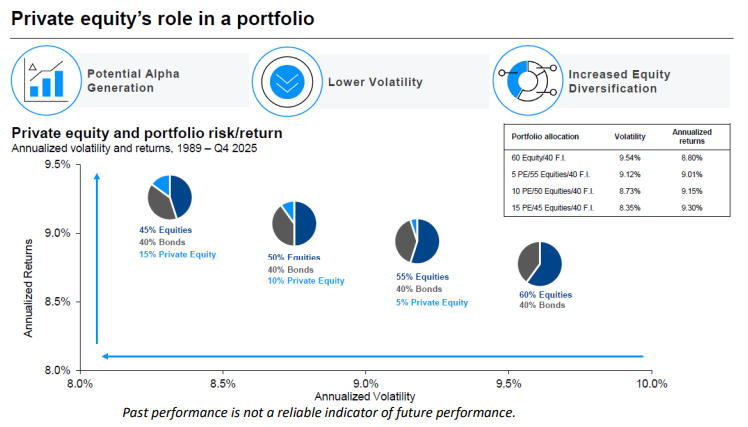
Historical results cannot tell us precisely what will happen in the future, and private assets have their own risks, including valuation risk and significantly lower liquidity. Nevertheless, the diversification principle is compelling.
The JPMorgan fund should therefore not be regarded as a replacement for listed equities or liquid defensive assets. Its Target Market Determination specifically describes it as a satellite allocation, with a minimum suggested holding period of five years, a high risk/return profile and limited liquidity requirements.
There is also an initial one-year lock-up. After that, withdrawals are generally considered quarterly but can be delayed in stressed conditions. This is genuine private-market exposure and should be treated accordingly.
For appropriate clients, however, this lack of daily liquidity is arguably part of the diversification
benefit rather than simply a disadvantage. The fund is not forced to price and trade its underlying businesses every day according to prevailing share market sentiment.
Final thoughts
We believe the present environment calls for discipline and to not run with the herd.
Our focus therefore remains on preserving capital, buying assets where expected returns justify the risks being taken, and ensuring portfolios have multiple diversified and independent sources of longterm return.
For suitable investors with a long-term investment horizon, we believe an allocation to the JPMorgan Private Markets Fund may provide another worthwhile source of portfolio diversification. In this regard, we have commenced reviewing client portfolios to identify those for which the Fund may warrant further consideration. Where appropriate, we will contact clients individually to discuss whether an allocation may be suitable having regard to their circumstances. However, please do not hesitate to contact us should you wish to discuss the Fund directly.
Please do not hesitate to contact our office if you have any questions on the above or your portfolio in general.

