
Last month we discussed the effect that sharply rising government bond yields had on asset prices. This month we want to look at the other side of the equation. As bond yields continue to rise, government bonds themselves are becoming an increasingly interesting investment proposition.
We have deliberately had very little exposure to traditional fixed-rate bonds for many years. When Australian Government bonds offered yields of 1%, 2% or even 3%, we did not believe investors were being adequately compensated for either inflation or the considerable capital risk associated with rising interest rates.
That equation may be starting to change. Australia’s 10-year Government bond yield is presently around 5.3%, compared with just 0.57% at its lowest in March 2020. If yields move sufficiently higher from here, an area of investment we have excluded for many years could become genuinely attractive.
A historical perspective
At the beginning of 1990, Australia’s cash rate was around 17% and the 10-year Government bond yield approximately 13%. Over the following 30 years, declining inflation, globalisation and technological advances contributed to a sustained reduction in interest rates, creating an extraordinary tailwind for bond investors.
As interest rates fell, bond investors benefited from both regular income and substantial capital appreciation. Consequently, $10,000 invested in Australian bonds in 1990 had grown to approximately $93,500 by 2020, representing an annualised return of 7.7%. Even after allowing for inflation, which approximately doubled consumer prices over the period, investors enjoyed real returns of around 5.3% annually.
By 2020, however, this favourable environment had effectively run its course. During COVID, the RBA reduced the cash rate to just 0.1%, while 10-year Government bond yields fell as low as 0.57%. At these levels, bonds offered very little income while exposing investors to substantial capital losses should interest rates rise.
That is precisely what followed. As inflation returned and interest rates increased, Australian 10-year Government bond yields climbed to approximately 5.3%, reversing the capital gains enjoyed over previous decades.
Over the past six years, a broad Australian bond portfolio has produced a cumulative nominal loss of approximately 5%, while consumer prices have increased by around 27%. The combined effect has been a 25% reduction in investors’ purchasing power, equivalent to an annualised real loss of approximately 4.7%.
This experience reinforces why we have deliberately avoided low-yielding Government bonds for many years. However, the same rise in interest rates that has damaged historical returns is progressively creating a more attractive investment opportunity, particularly if bond yields continue to increase over the coming months.
Interest rates continue to surprise on the upside
At its September meeting, the Reserve Bank increased the cash rate by another 0.25% to 4.60%, the fourth increase this year. Inflation remains stubbornly high, reflecting stronger-than-expected economic activity, capacity constraints and weak productivity growth.
In our view, Australia’s persistent inflation reflects excessive and inefficient government spending, rapid population growth and weak productivity. Whilst the Iran conflict has contributed through higher oil prices, overwhelmingly, Government spending and population growth continue to stimulate demand for goods, housing and services, while poor productivity constrains the economy’s ability to meet that demand, placing upward pressure on prices.
Both globally and domestically, continued government deficits are driving substantial government borrowing and extraordinary investment in artificial intelligence infrastructure are adding further inflationary pressures through increased demand for energy, labour and materials. At the same time, governments and tech giants are competing in the same debt markets for capital, placing further upward pressure on longer-term interest rates, a development also highlighted by the RBA.
These pressures suggest markets may be reassessing what constitutes a normal long-term interest rate, raising the possibility that the ultra-low rates experienced after the Global Financial Crisis may not return.
Getting closer – but not there yet
Following September’s increase, financial markets are pricing approximately another 0.45% in RBA rate increases through the remainder of this financial year, with similar inflationary and financing pressures persisting. Consequently, bond yields could rise further.
We recognise that waiting carries the risk of missing an opportunity should bond yields decline from current levels. Nevertheless, given the continuing inflationary pressures, we believe patience remains appropriate.
We believe an Australian 10-year Government bond yield approaching 6% would represent a materially more attractive investment opportunity, providing meaningful defensive income backed by the Commonwealth Government without relying on falling interest rates to generate an acceptable return.
Importantly, we are not suggesting that 6% would necessarily represent the peak in bond yields. Rates could rise further, resulting in short-term capital losses. Rather, we consider this a level at which the prospective returns would begin to adequately compensate investors for the risks involved.
It is worth recognising that households are considerably more indebted than in previous high-interest-rate periods. Household debt has increased from approximately 68% of disposable income in 1989 to 178% today. When adjusted for today’s much higher household indebtedness, a mortgage rate of 6.45% could place a comparable burden on household finances to the 17% rates experienced in 1989.
This heightened sensitivity means sustained elevated rates could substantially restrict spending, weaken economic growth and potentially trigger a recession. In that environment, longer-dated Government bonds purchased at yields approaching 6% could offer both attractive ongoing income and significant capital appreciation should any subsequent economic weakness eventually drive bond yields lower.
Why falling rates could produce substantial capital returns
If inflation was successfully brought back under control and a more normal long-term Australian Government bond yield eventually settled at around 4%, investors purchasing longer-dated bonds at yields around 6% could potentially receive substantial capital appreciation in addition to the interest earned while holding the bond.
To illustrate this, we have considered four existing Commonwealth Government bonds.
At one end is GSBI38, which pays a 5.00% coupon and matures in May 2038. Its relatively shorter maturity and higher coupon make it the least sensitive of our examples to movements in interest rates. At the other extreme is GSBK51, which pays only 1.75% annually and does not mature until June 2051. Its very low coupon and long maturity mean its value is extremely sensitive to changes in long-term interest rates. Between the two are GSBI41, paying 2.75% and maturing in May 2041, and GSBK54, which matures in June 2054 but carries a considerably higher 4.75% coupon.
The following table is illustrative.
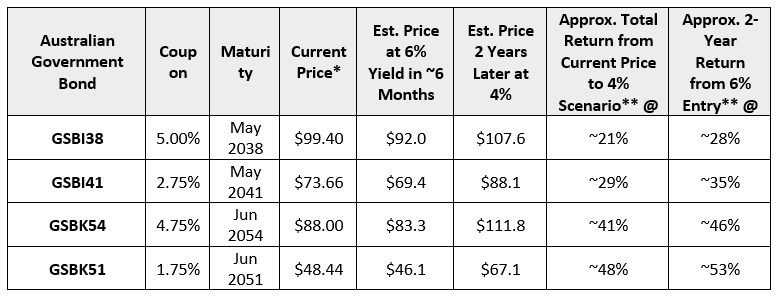
* Indicative market prices at the time of writing.
** The current-price scenario assumes a holding period of approximately 2.5 years. The alternative scenario assumes bond yields rise to 6% over the next six months, at which point the bonds are purchased and held for two years, during which yields decline to 4% as inflation comes under control. Both scenarios include coupon income but exclude taxation, transaction costs and reinvestment of coupons.
@ This effectively assumes a broadly parallel movement in the yield curve. In practice, the 10-year, 15-year and 25-year parts of the curve will not necessarily move by the same amount, so the results should be regarded as an illustration of bond sensitivity rather than a forecast.
The table demonstrates two important principles.
First, the starting yield matters considerably. Waiting for yields to reach approximately 6% materially improves both the income being received and the potential capital return should yields subsequently decline.
Second, the potential for higher returns from longer-dated bonds comes with substantially greater interest-rate risk that is magnified by the level of annual coupon paid. For example, GSBK51 currently trades below $50 but will be redeemed for $100 in 2051, paying just $1.75 annually in interest (3.80% at current trading levels). Its price is therefore highly sensitive to changes in bond yields, offering substantial capital appreciation if yields fall, but equally significant losses if they rise. By comparison, GSBK54’s higher 4.75% coupon (5.70% at current trading levels) provides greater ongoing income and somewhat reduces this sensitivity.
We would therefore not simply purchase the bond offering the largest theoretical capital gain. An eventual allocation would more likely be spread exposure across maturities and coupon structures, balancing income certainty against the potential capital gain that would be achieved should interest rates fall.
Government bonds are likely to be our focus
Higher interest rates are also improving prospective returns from corporate and bank bonds. However, if the eventual catalyst for falling interest rates is a meaningful economic slowdown or recession, the distinction between government and corporate bonds becomes important.
Commonwealth Government bonds carry negligible solvency risk and are generally considered risk free – our Federal Government retains the option of raising taxes! By contrast, corporate bonds introduce the additional risk that a weaker economy places pressure on company earnings, balance sheets and ultimately the ability of some borrowers to meet their obligations.
During periods of economic stress, corporate credit spreads can widen substantially, potentially offsetting the capital appreciation that would otherwise result from falling Government bond yields.
For that reason, if we decide to increase exposure to traditional fixed-rate securities, our initial preference is likely to be Australian Government bonds.
Looking Ahead
We remain prepared to be patient as the interest-rate cycle unfolds. However, for the first time in many years, Australian Government bonds are approaching yields at which we believe they could offer an attractive combination of defensive income and potential capital appreciation.
If that point arrives, we want investors to understand why we are entering an asset class that we deliberately avoided when prospective returns were inadequate. We envision the potential for allocations of up to 10% of portfolio values in this area, which is still significantly less than the ‘traditional 60% shares /40% bonds’ hypothetical model portfolio allocation.
Importantly, this would not represent a change in our investment philosophy. Rather, it reflects our longstanding approach of investing where prospective returns adequately compensate for the risks involved, while maintaining our focus on capital preservation, sustainable income and attractive long-term returns.

